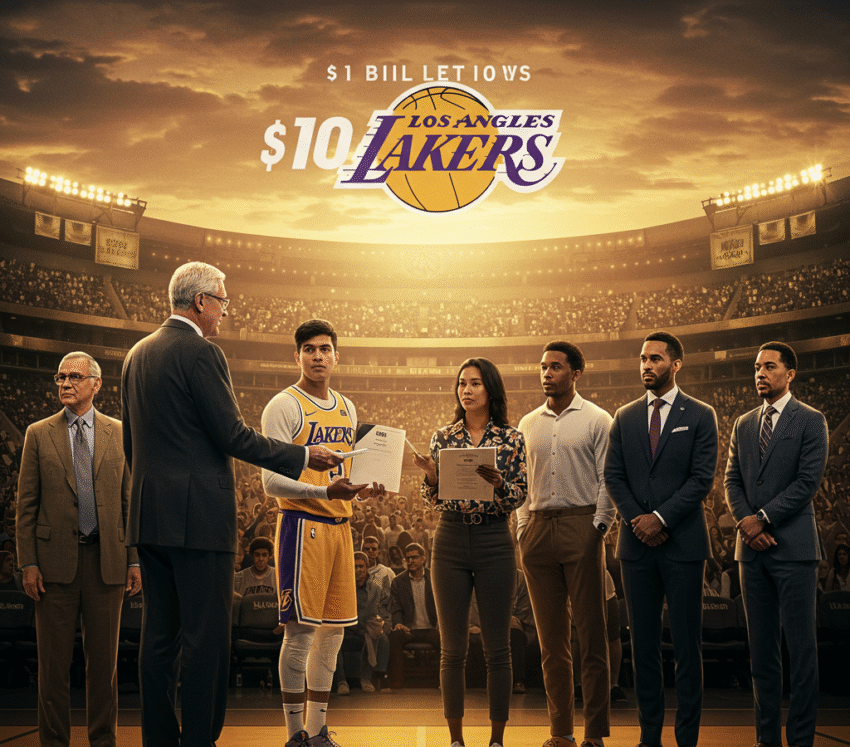
Breaking Down the $10 Billion Sale: What the Buss Family’s Lakers Deal Means
When you think about legendary basketball teams, the Los Angeles Lakers are almost always at the top of the list. They’re more than just a sports team—they’re a global brand, a piece of Hollywood history, and a family legacy. But recently, the basketball world got quite the jolt when news broke that the Buss family is considering selling a stake in the Lakers at a jaw-dropping $10 billion valuation.
You might be wondering: is this just another business deal, or does it mean big changes for one of the NBA’s most iconic franchises? Let’s break it down in simple terms and explore what this move could mean for the team, the family, and the future of basketball.
Why Is This Sale Such a Big Deal?
The Los Angeles Lakers aren’t just worth a lot—they’re worth a ton. We’re talking about a franchise that has won 17 NBA championships, has a global fan base, and a long list of superstar players like Magic Johnson, Kobe Bryant, and LeBron James.
Now, the Buss family, who’ve owned the Lakers since 1979, is reportedly looking to sell part of their ownership. If the sale goes through based on a $10 billion valuation, it would set a new high-water mark for a professional basketball team.
Just to put things into perspective, let’s take a quick look at this in table form:
| NBA Team | Recent Valuation |
|---|---|
| Golden State Warriors | $7.7 Billion |
| New York Knicks | $6.6 Billion |
| Los Angeles Lakers (estimated in new deal) | $10 Billion |
As you can see, the Lakers’ estimated value in this deal leaves other top NBA teams in the dust.
Who Is the Buss Family, and Why Does This Matter?
The Buss family’s connection to the Lakers began with Dr. Jerry Buss. When he bought the team in 1979, he turned the Lakers into a household name. He was the mastermind behind the team’s “Showtime” era, blending sports and entertainment like never before.
Since his passing in 2013, the ownership of the team has been shared among his six children, with Jeanie Buss serving as the controlling owner and team president. Under her leadership, the Lakers won the 2020 NBA title, and she’s been praised for keeping the team competitive both on and off the court.
But shared ownership can be tricky. It’s been reported that not all siblings agree on the direction of the team—or the family business. Selling a stake in the team would not only bring in cash but could also simplify decision-making.
What Could Happen If a Stake Is Sold?
Let’s be clear: the family isn’t selling the whole team. And as of now, there’s no final deal. But even selling a minority stake could have ripple effects. Here’s what it could lead to:
- New investors could step in, bringing fresh ideas and influence.
- More resources for player development, marketing, and arena upgrades.
- Potentially a step toward a full sale down the road if family dynamics make it harder to stick together.
Think of it like someone selling a part of a family-owned restaurant. It’s still in the family, but bringing in a new business partner might change the menu—or even the vibe of the place. The same goes here.
Why Now?
You might ask, “Why would they consider selling at all?” That’s a great question. There are a few reasons:
- High valuations: The market for sports franchises has been booming. It’s a seller’s market.
- Family tension: With six siblings co-owning the franchise, coordination and consensus can be hard. Cashing out could be simpler.
- Long-term vision: A partial sale could give the family the capital to invest in other ventures or fund improvements for the team.
What Does This Mean for Fans?
The big question for fans is whether this will change the product on the court. Most likely, the core of the team will stay intact. Jeanie Buss remains deeply involved and passionate about the Lakers’ legacy. And with a valuation this high, any new investors are going to be very careful about protecting the brand.
From a basketball point of view, the Lakers will likely continue doing what they’ve always done—go after big-name players, compete for titles, and stay in the spotlight.
How Does This Compare to Other Sales?
This valuation blows previous sales out of the water. Earlier this year, the Washington Commanders (NFL) were sold for $6.05 billion. The Phoenix Suns (NBA) went for $4 billion. But $10 billion? That’s not just another level—it’s another league.
We’re seeing a trend: elite sports franchises are becoming like luxury assets—think fine art, rare real estate, or vintage cars. But in this case, you’re also buying into a global fanbase, TV rights, merchandising, and more.
The Business of Sports Is Booming
Let’s be honest: owning an NBA team isn’t just about wins and losses. It’s also about business. Teams are making millions—sometimes billions—through:
- Broadcasting rights
- Sponsorship deals
- Ticket sales and merch
- Global expansion, especially into markets like China and Europe
So when someone pays $10 billion for a team, they’re not just buying athletes. They’re investing in a money-making machine with tons of potential.
Final Thoughts: The Purple and Gold Future
To fans, the Lakers are more than a basketball team—they’re part of their identity. So, any change in ownership, even partial, can feel personal.
But here’s the silver lining: while the business side may be shifting, the love for the game—and for the Lakers—remains just as strong. The team’s legacy is built on stars, success, and spectacle. And that’s not changing any time soon.
Whether you’re a diehard fan or just love a good business story, the possible stake sale of the Lakers shows how sports, family, and finance all mix in today’s world. Who knew one basketball team could tell such a powerful tale?
So what do you think—could this be the start of a new “Showtime” era, just with a few new faces behind the scenes?
Keywords:
Los Angeles Lakers valuation, Buss family selling Lakers, Lakers $10 billion, NBA team ownership, Jeanie Buss news, sports team business, Lakers ownership change, Buss family NBA