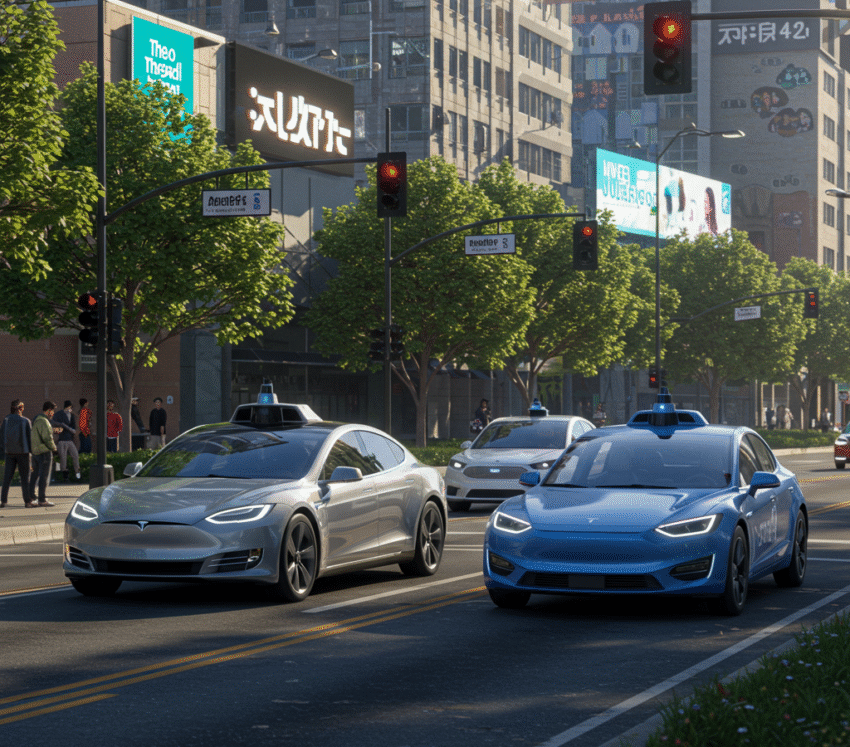
How Tesla’s Robotaxi Vision Stands Against Waymo and Zoox in the Self-Driving Race
Imagine a world where you open an app, summon a car with no driver, and get whisked away to your destination—all without touching a steering wheel. Sounds like a scene from a sci-fi movie, right? Well, that future is much closer than you think, thanks to companies like Tesla, Waymo, and Zoox.
In the race to dominate the self-driving car market, these three companies are going full throttle. But what sets them apart? And how close are they to making robotaxis a part of our everyday lives? Let’s take a look.
The Rise of Robotaxis: A Quick Overview
Autonomous or self-driving vehicles have been making headlines for years, promising to transform the way we travel. They aim to reduce accidents, cut down on traffic, and even lower pollution. But turning that promise into reality is easier said than done.
Companies like Tesla, Alphabet’s Waymo, and Amazon-owned Zoox are among the front-runners. Each has its own strategy, technology, and roadmap for launching a fleet of driverless vehicles, also known as robotaxis.
So, who’s doing what? Let’s break it down.
Comparing Tesla, Waymo, and Zoox: Who’s Where Right Now?
Here’s a simple table to show how Tesla stacks up against Waymo and Zoox in the robotaxi game:
| Company | Ownership | Self-Driving Level | Vehicle Type | Operational Area | Commercial Service |
|---|---|---|---|---|---|
| Tesla | Independent | Level 2 (FSD Beta in testing) | Modified Tesla cars | Private beta testing in various U.S. cities | No public service yet |
| Waymo | Alphabet (Google’s parent) | Level 4 | Custom Chrysler Pacifica & Jaguar I-Pace | Phoenix, San Francisco, Los Angeles | Public service in select cities |
| Zoox | Amazon | Level 4 (testing only) | Custom-built robotaxi (no pedals/steering) | Testing in Las Vegas, San Francisco | No commercial rollout yet |
Tesla’s Vision: Full Self-Driving with Style
Let’s start with Tesla. Elon Musk has been promising a fleet of self-driving robotaxis for years. Tesla’s approach is a bit different from its competitors. While others use expensive sensors and external computing systems, Tesla relies heavily on cameras and real-time data processed through its Full Self-Driving (FSD) software.
Currently, Tesla’s FSD tech is considered Level 2 autonomy. That means the car helps you drive, but you still have to keep your hands on the wheel and be ready to take over at any moment. However, Musk claims that Tesla is rapidly moving toward Level 4—where the car can drive itself entirely within certain conditions.
In fact, Musk recently teased that Tesla would unveil its purpose-built robotaxi vehicle in August 2024. Unlike their current cars, this model would be fully autonomous and specifically designed for ride-hailing. Still, as of now, Tesla hasn’t launched any commercial robotaxi service.
Pros of Tesla’s Approach:
- Existing fleet of vehicles means faster scaling.
- In-house hardware and software reduce dependency.
- Massive amount of real-world driving data from customer vehicles.
Challenges:
- Software is still under development and hasn’t hit full autonomy.
- Lacks regulatory approval in many areas.
- No dedicated driverless vehicle on the road yet.
Waymo: The Quiet Achiever
Unlike Tesla, Waymo is already offering driverless rides to the public in select cities like Phoenix. It uses Level 4 automation, which means the car can handle almost all driving tasks on its own in a geofenced area.
Waymo’s vehicles are equipped with lidar, radar, cameras, and highly detailed maps. They’re expensive to build—but they work. Riders can hail these driverless minivans just like they would with Uber or Lyft, only there’s no driver.
This puts Waymo ahead in terms of actual deployment. It’s the first to offer a commercial service where nobody’s sitting in the driver’s seat.
Why Waymo Stands Out:
- Already offers driverless rides in major U.S. cities.
- Proven technology with years of testing and data.
- Strong parent company backing (Alphabet).
But even Waymo has to tread carefully. Expanding to new cities takes time, and each area needs customized mapping and testing. That limits how quickly they can scale.
Zoox: The Robotaxi Redefined
Now, here’s a company that’s starting with a clean slate. Amazon’s Zoox isn’t tweaking existing cars—it’s building a self-driving vehicle from the ground up. Imagine a compact, symmetrical car with no steering wheel or driver’s seat. That’s the Zoox vision.
The custom-built vehicle is designed entirely for passenger comfort. Flattened floors, facing seats, and no driving features show how serious Zoox is about autonomy. But the service has yet to go live for the public.
What Makes Zoox Unique:
- Purpose-built vehicle without traditional driving controls.
- Innovative design tailored for ride-sharing.
- Strong backing from Amazon.
However, the bold concept brings its own set of challenges. Building the infrastructure, securing approvals, and ensuring safety have made Zoox’s journey slower.
So, Who’s Winning the Race?
If we’re just talking about deployment, Waymo is the current leader. It’s already offering real, driverless rides to everyday people. Tesla, on the other hand, has grand ambitions but is still in the testing phase. Zoox is working on something revolutionary but has a longer road ahead.
That said, Tesla’s massive fleet and data advantage could give it a surprising lead in the future—if it nails the software and gets the green light from regulators.
What This Means for You and Me
Most of us still rely on our own cars or ride-shares with drivers. But over the next few years, that could start to change. Imagine commuting to work without having to drive. Or sending your kid to school in a safe, fully autonomous vehicle. The possibilities are endless—and they’re coming faster than we think.
Of course, we’ll need to trust these technologies, and that will take time. But with major players like Tesla, Waymo, and Zoox paving the way, it’s not a matter of “if,” but “when.”
The Road Ahead
Self-driving cars used to be a futuristic fantasy. Now, they’re becoming a reality—though the finish line isn’t quite in sight yet. Each company is approaching the challenge differently, and that variety might be one of the industry’s biggest strengths.
Whether it’s Tesla leveraging its fleet, Waymo perfecting its autonomous rides, or Zoox reinventing the car altogether, the race is on. And eventually, we’ll all benefit from safer, more efficient, and more accessible transportation.
Which robotaxi would you ride in first—Tesla, Waymo, or Zoox? Let us know in the comments!